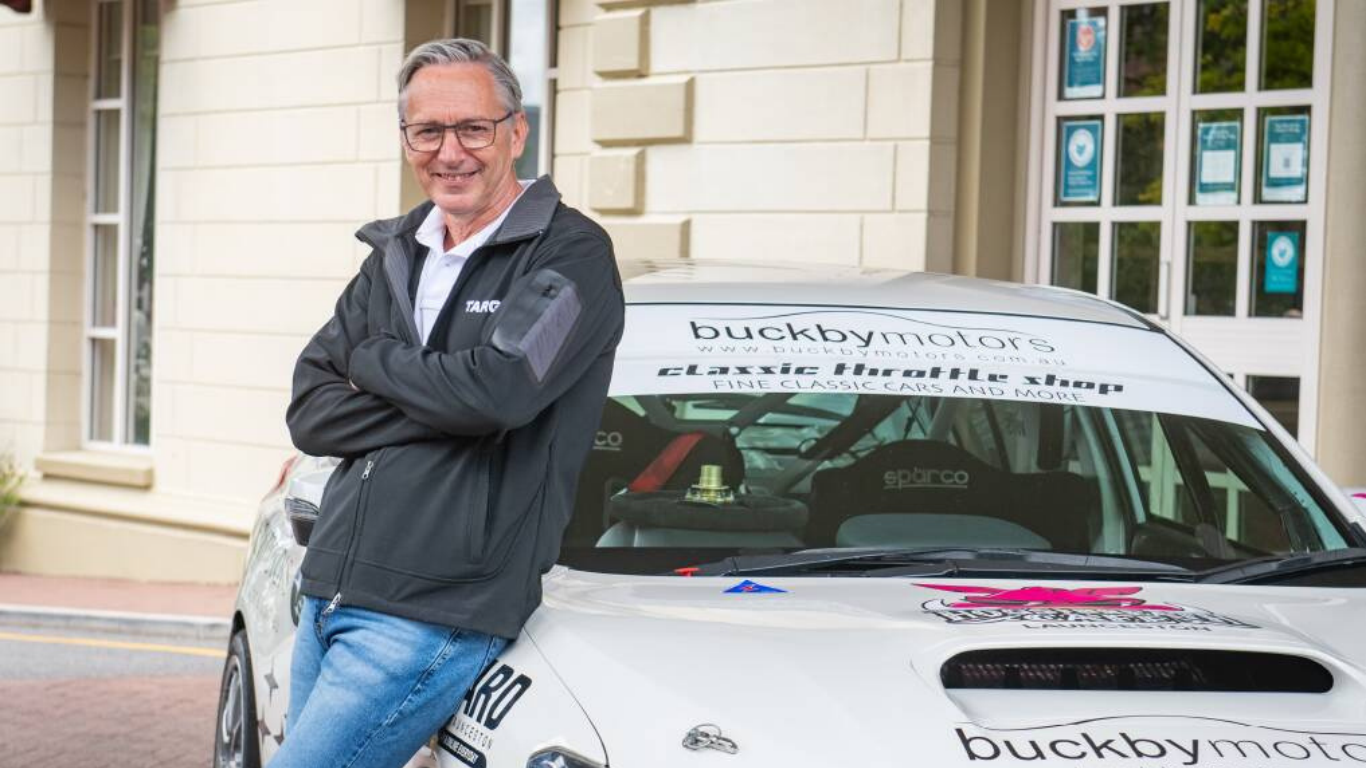
Famous Insurance ambassador Glenn Ridge sits down with Targa Tasmania CEO Mark Perry to talk about the event’s remarkable return, the people who kept believing in it, and what comes next for one of Australia’s great motoring events.
Few events in Australian motoring carry the history, emotion and sense of community that Targa Tasmania does.
After a difficult few years, 2025 marked the long-awaited return of Targa. For CEO Mark Perry, simply getting the event back on the road was an achievement worth celebrating.
As he tells Glenn Ridge in their recent conversation:
“It’s a miracle we got it back.”
That comment perhaps sums up just how challenging the journey has been.
Mark is quick to acknowledge the people and organisations who continued to believe in Targa, including Dutton Automotive and the Tasmanian Government, along with the competitors, officials and volunteers who make the event possible.
Importantly, the returning event also achieved a significant milestone, with Mark noting there was not one medical intervention required during a live stage.
Mark’s relationship with Targa stretches back decades, although the path to becoming CEO wasn’t necessarily part of the plan.
After a crash in 2003, his career took a different direction and he even pursued a role in motorsport powerhouse V8 Supercars, eventually leading to an executive role and it was an experience Mark remembers honestly.
“I wasn’t built for it. It was very political and trying to cut costs but keep people happy.”
He can laugh about it now, adding:
“I can admit it was more than what I could do, and I look back fondly at the experience.”
Before long, however, Targa came calling again. Mark returned as a 50 per cent owner, beginning another chapter in his long association with the event.
And despite everything the Targa family has navigated since, his commitment today remains pretty difficult to question.
When Glenn asks whether there was ever a moment when he thought about walking away, Mark’s answer is wonderfully straightforward:
“My better half said, ‘You’re not good at anything else.’”
Sometimes that is all the motivation you need.
Numbers may have been lower for the return in 2025, but one thing clearly hadn’t disappeared: the passion surrounding the event.
“If you know me, you know it’s not going anywhere.”
Mark talks warmly about the volunteers who rallied around Targa, the competitors who held onto their cars through the uncertainty, and the officials who simply wanted to be part of the event again.
At officials’ BBQs, he says, volunteers often talk about how much they value meeting competitors, making new friends and feeling part of something much bigger than a motorsport event.
That community has always been one of Targa’s greatest strengths.
And there are encouraging signs for the next chapter, with Mark saying around 95 per cent of people from last year are returning this year.
Why November?
The move to November has created challenges, but Mark believes the benefits are significant.
“November is a double-edged sword. It’s a busier time of the year and we are determined to stay here.”
For Tasmania, however, November means warmer weather, longer daylight hours and more opportunity to build experiences around the event for competitors, families and spectators.
The challenge is competing with an already crowded calendar.
For Mark, the answer is to keep demonstrating just how good the Targa experience can be at this time of year.
And importantly, he believes Targa doesn’t need to pretend to be something it isn’t.
“It’s not the WRC. It’s about having a great time.”
That sentiment goes right to the heart of where Targa appears to be heading.
One of the most interesting parts of Glenn and Mark’s conversation is how Targa is creating new entry points for people who love the event but can’t necessarily commit to the traditional format.
Targa Trofeo is an important part of that strategy.
The three-day format recognises that newcomers can find the full event daunting, while others simply don’t have the time available for five days of competition plus transit and preparation.
Instead, Trofeo provides an alternative competition while also creating an environment where participants can gain experience, learn how Targa works and potentially progress through the performance tiers.
As Mark explains, it also gives younger enthusiasts an opportunity to get involved and try the event.
For the long-term future of Targa, that accessibility matters.
Not everyone needs to compete, either.
Targa Tours provide another way to experience Tasmania’s extraordinary roads and the social side of the event without entering outright competition.
Mark highlights manufacturers such as Porsche and Subaru, which can use the format to put customers or media into their cars in a less restrictive environment.
“Tour gives you the experience, social camaraderie but without the risk of competition.”
For someone who has always watched Targa from the outside and wondered what it would be like to participate, the Tour represents a very different pathway into the Targa family.
Mark also discusses the evolution of the GT categories and the realities of preparing modern cars for Targa competition.
Historically, turning something like a showroom Lamborghini into an appropriate GT-style Targa car could mean buying a vehicle from a showroom at substantial cost and then spending another $100,000 or more on safety preparation.
Today there are significantly more purpose-built or near race-ready GT-style cars available.
That creates opportunities for competitors to purchase machinery that is already suited to the task rather than starting with an expensive road car and undertaking a major conversion.
It’s another example of Targa looking at how it can lower the barriers to participation while preserving what makes the competition special.
Perhaps the strongest message from the conversation is that nobody involved wants to reinvent Targa simply for the sake of it.
It’s about taking everything that made the event iconic, learning from an extraordinarily difficult period and creating something sustainable for the future.
Mark puts it simply:
“We’ve got an incredible history. The last four or five years have been tough on the Targa family, but we are on the dawning of a new era and there’s a lot to look forward to.”
Glenn shares that optimism.
For someone with his own long history around cars and motorsport, seeing Targa moving forward while reconnecting with the enjoyment, the roads and the camaraderie of earlier events is something worth getting excited about.
And we couldn’t agree more.
At Famous Insurance, Targa represents so much of what we love about the Australian motoring community. Incredible cars are obviously part of it, but ultimately it’s the people, the shared experiences, the friendships and the stories created along the way that make events like this special.
Targa is back. And perhaps the most exciting part is that its next chapter is only just beginning.