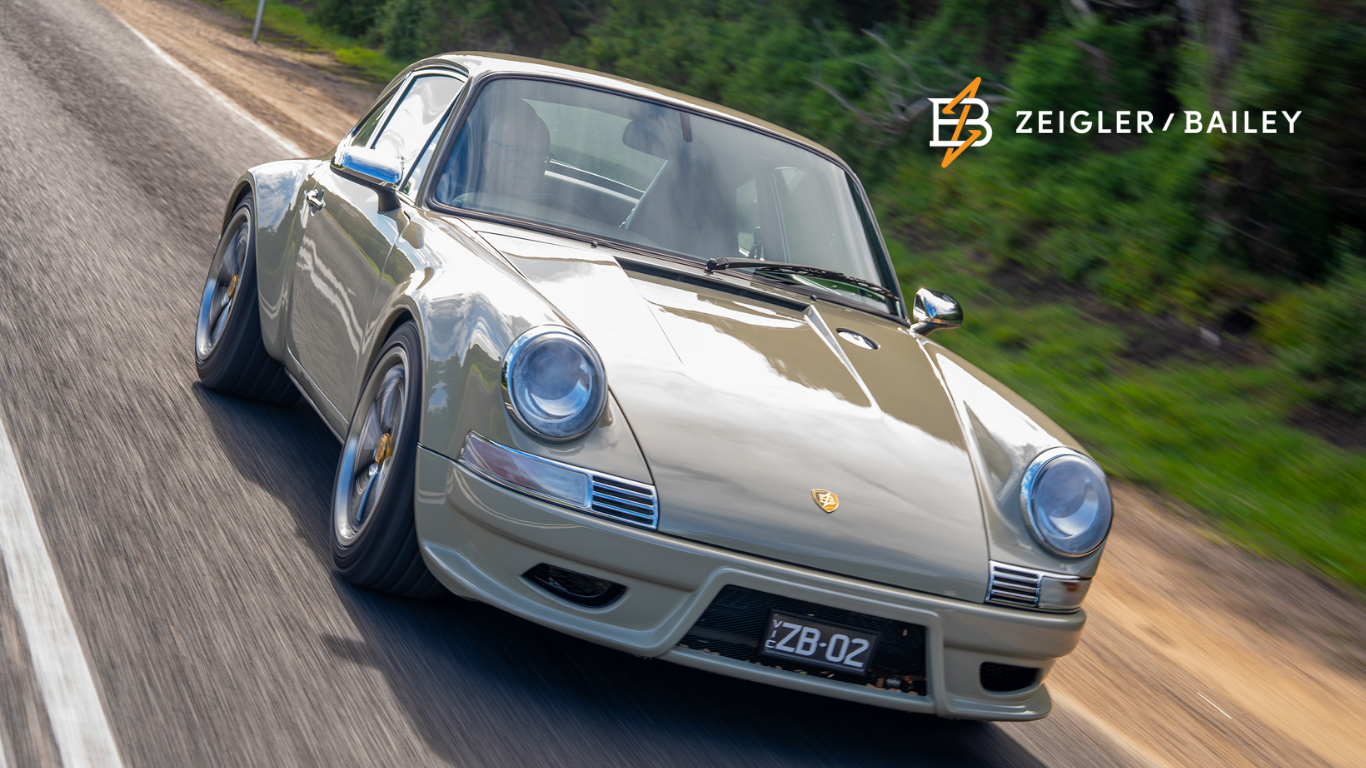
The Zeigler/Bailey Z/B 4.4 is Porsche royalty re-engineered and re-imagined. And almost no one knows it exists…
The car looks, at a glance, like a 1973 Porsche 911 Carrera RS. Long bonnet, ducktail spoiler, fat rear arches, five-spoke wheels and the right kind of stance…
It isn’t.
The bodyshell is the only meaningful link to Stuttgart, and even that has been reskinned, reinforced and seam-welded to within an inch of its life. Everything else – chassis, suspension, electrics, engine, gearbox internals, switchgear, instruments, wheel nuts (yes, wheel nuts) – has been designed from a blank screen and built or sourced by a small team in inner Melbourne.
This is the Zeigler/Bailey Z/B 4.4. It costs $1.6 million plus a donor car. Six are near-complete, another six are in planning, and if you haven’t heard of it, you’re in good company.
But that’s about to change.
Not a restomod
The word restomod gets thrown at the Z/B 4.4 quite a lot. Co-founders John Zeigler and Greg Bailey aren’t fans, and once you understand what they’ve done, you’ll see why.
A restomod, properly defined, takes a classic and freshens it: trim, brakes, perhaps an engine rebuild with a few extra cubic centimetres. Zeigler tried that approach early on, with a 964. He stood back at the end and asked himself what they’d actually achieved. The answer, he admits, was nicer furniture.
So, they asked a better question – what would Ferdinand Porsche do today with access to current manufacturing technology – and started over.
The Z/B 4.4 shares a silhouette with a G-series Porsche 911 (1975 to 1989, the impact-bumper cars) but almost nothing else. The floor of the car has been cut out and replaced with a symmetrical sheet-steel tub, meaning modern 911 seats fit, and the entire driving configuration can be swapped from right-hand drive to left in a day. For a $1.6 million car sold into a global collector market, that’s not a parlour trick. It’s resale strategy.
The rear suspension is lifted, in concept, from Bailey’s own Le Mans LMP2 prototype: pushrod-actuated dampers across a CNC-machined aluminium bulkhead, titanium pushrods, rising-rate linkage. Up front, custom MacPherson struts with four-way adjustable damping via remote reservoirs. The original G-series torsion bars and trailing arms are in the bin where, frankly, they belong.
All engineered to current Australian Design Rules, by the way.
The 4.4-litre question
Tell someone you’ve made a 4.4-litre air-cooled flat-six that fits in the back of a Porsche 911, and you’ll get one of two reactions. Mild disbelief from anyone with passing knowledge of the breed – Porsche’s own air-cooled sixes topped out around 3.8 litres – and harder disbelief, plus a list of reasons it shouldn’t work, from anyone who’s tried.
Bailey did it anyway. A full-fat, full-caffeine, full-gluten 4.4-litre flat-six, machined entirely from billet aluminium (block, cylinders, cylinder heads) and incorporating more than 1200 unique parts—not a single casting. The exhaust system is 3D-printed in stainless steel. Zeigler/Bailey believes it’s a world first at that scale. No one has yet stepped forward to argue.
Outputs are targeted at 300 kW and 500 Nm. At the time of writing, with ECU mapping still being refined, the engine is sitting at around 260–270 kW and 420 Nm on the dyno.
On target, that puts the Z/B 4.4 slightly ahead of the current, water-cooled turbocharged Porsche 911 Carrera (290 kW, 450 Nm) – a fact worth pausing on, because the Carrera has 40-plus years of incremental development on its side. The Z/B engine also meets the 1986 ADR limits for sound and emissions applicable to the donor car, and matches Porsche’s final air-cooled engine, the 993-series of 1998. Catalytic converters are cartridge-type, so tightening emissions targets can be met without re-engineering the exhaust.
Behind the engine sits a Getrag G50 five-speed manual. A limited-slip differential is standard. Driveshafts are custom, with GKN tripod constant-velocity joints. Bailey designed the crankshaft with larger main bearings, fed directly from the crankcase rather than through the crank itself, solving, at a stroke, one of the original engine’s classic high-rpm oiling weaknesses.
For the avoidance of doubt: there is no second source for any of this. Zeigler/Bailey designs it, owns the drawings, and controls the build. The engine is theirs.
And so to drive
The Z/B 4.4 is, by Zeigler and Bailey’s own admission, a work in progress. The car I drove is a prototype, with public-road restraint imposed on what is clearly a very rapid machine. So, this is not the definitive verdict. But what’s there is a masterpiece in the making.
The bones of an old G-series 911 are in here, with the things that used to drive you mad gone. There’s room for your feet and a proper pedal box. The interior has not a creak nor a rattle. The Brembo four-pots from a 997 have very little to do in a car this light.
Suspension, owner-specified anywhere between Carrera-soft and GT3-firm, is properly damped without the banging and crashing of some modified originals.
The torque curve is the giveaway: close to peak from under 3000rpm all the way to the 7200 redline. The gated shift adds drama that the old Porsche box never had. The G50 transmission is the weak link, and Bailey is already on it.
Subtle to look at. Not at all subtle when you put your foot down.
A question of why
Zeigler talks about scale in terms of numbers that seem small until you do the maths. Ten cars a year for Australia, 50 internationally. Then there’s the engine on its own as a product, separately saleable into the global air-cooled aftermarket, where Zeigler sees room for as many as 1000 units annually.
And underneath all of that, a production management software platform that Bailey built because nothing off-the-shelf could handle 3500 bespoke parts per car. That, he reckons, has a life of its own.
You can have a long argument about whether any of it comes off. But for now, in 2026, in a shed in Cremorne (Vic), ‘Block A’ of the cars is real, the engines are running, and the company is taking deposits.
Six cars are nearly finished. Six more are in planning. A team of 14 that includes CAD designers, engineers, and assemblers, plus an advisory board that draws on some of the most experienced minds in the country’s premium automotive industry.
If that’s not the most quietly ambitious thing happening in Australian motoring right now, I don’t know what is.